Built around your specific sleep
Your session is generated from your own consultation. We ask what your sleep looks like, what disrupts it, what would change. Built around your specifics.

Deep sleep is the phase where the body actually recovers. It depends on a settled nervous system arriving at bedtime, not on willpower or longer hours.
Sleep happens in cycles — light sleep, REM, and slow-wave (deep) sleep. The deep phase is what actually restores the body: growth hormone releases, immune function regenerates, the brain's glymphatic system clears metabolic waste. Without sufficient deep sleep, 8 hours in bed produce 4 hours of useful rest. Many adults wake unrefreshed despite long sleep durations because their deep-sleep proportion has thinned.
Common causes: chronic activation (the body too braced to drop deep), alcohol (suppresses slow-wave sleep), late-evening screens (delays deep onset), late caffeine, irregular timing. The work that lasts addresses the underlying nervous-system state that allows the brain to access the deep phase reliably.
Multiple awakenings, light dreams, never feeling like you went under. Often invisible — you slept, but not deeply.
8 hours in bed, still tired. The diagnostic sign that deep sleep is the missing piece, not duration.
Drinking helps you fall asleep but suppresses slow-wave. The hidden cost of evening alcohol.
High activation through the day producing thin sleep at night. The body too on-guard to descend.
Late screens delaying both sleep onset and the deep phase that follows it.
Slow-wave sleep naturally diminishes with age but the decline can be slowed with practice.

Deep-sleep access depends on autonomic state. A regulated nervous system descends into slow-wave; a braced one stays in light sleep. Trying harder to sleep deeply doesn't work because trying is the wrong direction — descent requires letting-go, not effort.
Hypnotherapy works at exactly the autonomic level. Rather than instructing sleep, it offers the deeper mind the conditions: settled body, quieted mind, parasympathetic dominance. Sleep then deepens naturally. The American Psychological Association recognises hypnotherapy as an evidence-based psychological approach.
Most sleep content is sleep-hygiene checklists. The session works on the underlying state that allows deep sleep to happen.
Your session is generated from your own consultation. We ask what your sleep looks like, what disrupts it, what would change. Built around your specifics.
Settled body → parasympathetic dominance → deep-sleep access. The session works on the chain.
Three short voice recordings during the consultation are analysed for emotional tone. Chronic-activation signature shows in voice; the session is calibrated accordingly.
Every Hypnotrack pathway is built on clinical frameworks from a qualified hypnotherapist — registered, National Hypnotherapy Society (HYP16-03742).
The Sleep & Recovery pathway is designed for the specific shapes deep-sleep difficulty takes. Some may sound familiar.
The tossing kind. The session works on settling the underlying state.
The diagnostic sign. The session targets the depth, not the duration.
High-stress periods producing thin sleep. The session can be re-listened to during particularly loaded weeks.
When alcohol use has been heavy, deep sleep takes weeks to recover. The session supports the rebuild.
The slow-wave decline that comes with hormonal and age-related shifts. Slower with consistent practice.
After insomnia, illness, or grief — rebuilding the body's capacity to descend.
Your session is around 15 minutes of personalised hypnotherapy audio. It opens with breath and grounding work — the foundation of parasympathetic descent.
It moves into recognition of your specific sleep pattern. New patterns are introduced: the felt sense of settled descent, the body letting go, slow-wave access becoming reliable. Future-pacing — what mornings feel like with deep sleep restored. Yours forever, designed to be listened to in bed as a pre-sleep ritual.
Built from your own consultation — your specific sleep, your own language, the version of you who wakes restored.
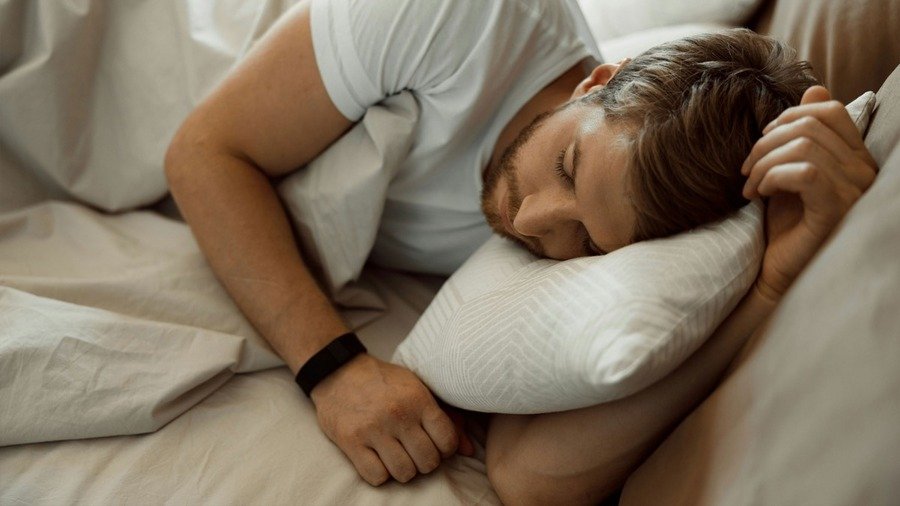
We won't promise sleep in one listen. Deep sleep depends on sustained practice with the underlying state, plus practical sleep hygiene the session can support but not substitute for.
If poor sleep is part of sleep apnoea (snoring, witnessed pauses, daytime fatigue), please see your GP and request a sleep assessment. Apnoea-related sleep difficulty needs its own treatment. NHS sleep guidance.
Many people notice a meaningful change within 1–2 weeks of consistent listening — waking more rested, less foggy, with more sustained energy through the day.
Yes — designed for it. Headphones at low volume, lights off, ready to sleep. The session is timed to support descent rather than to require attention.
If you snore, wake gasping, or partner has witnessed pauses in breathing, please get a sleep assessment. The session helps with state-related sleep difficulty, not with apnoea, which has its own treatment.
The session is supportive, not a medical replacement. If you're on sleep medication, please coordinate any changes with your GP — many people use the session alongside, with reduction often a downstream effect.
Variable. Subjective improvement often within 1–2 weeks. The deeper restructuring of sleep architecture usually takes months.
Around 15 minutes. Delivered within 30 minutes. Yours forever.
No specific belief is required. You remain in control throughout.