Built around your specific evening pattern
Your session is generated from your own consultation. We ask what time the anxiety starts, what it sounds like, what would change. Built around your specifics.

Pre-sleep anxiety is the anticipatory activation that builds as bedtime approaches — the body bracing for an outcome it expects. The bracing itself produces the outcome it fears.
The anxiety that builds towards bedtime is anticipatory, not present. The day was fine. The dread arrives around 9pm — chest tightening, breath shallowing, mind starting to forecast. The body is bracing for the difficulty it expects falling asleep, often based on a recent history of bad nights. The bracing raises activation, lowers parasympathetic tone, and makes the predicted difficulty more likely. The loop closes: anxiety produces poor sleep, poor sleep reinforces anxiety, next evening the anxiety arrives earlier.
Common origins: a stressful period that disrupted a few nights, the body anticipating more disruption, the anticipation becoming the cause. Often persists long after the original trigger has passed. The trap is trying harder to relax in the evening, which adds another performance demand. The work that lasts breaks the anticipatory loop.
Calm through the day, anxiety arriving on schedule with the wind-down. The signature timing.
Somatic anxiety meeting the bedroom. The body's bracing made physical.
Lying awake imagining how broken the next day will be. The forecasting amplifying the activation.
Staying up later to avoid the moment. The avoidance making the loop worse over time.
Treating sleep as a goal to achieve. The exact frame that prevents it.
The room itself triggering the surge. The conditioned response that's harder to undo than to form.

Standard anxiety advice — breathe, reframe, talk yourself down — works at the cognitive level. Pre-bed anxiety is partially cognitive but largely conditioned and autonomic. The body has learned to surge at 9pm. Telling yourself the surge is irrational doesn't reach the body that's surging.
Hypnotherapy works at the autonomic level and on the conditioning simultaneously. The trance is parasympathetic-dominant, offering the body a route into descent that breaks the activation loop. With repetition the evening becomes a cue for the settled state rather than the dread state. The American Psychological Association recognises hypnotherapy as an evidence-based psychological approach.
Most pre-bed anxiety content is breathing techniques or sleep hygiene. Useful but generic. The session works on the anticipatory loop itself.
Your session is generated from your own consultation. We ask what time the anxiety starts, what it sounds like, what would change. Built around your specifics.
The session works on the evening as a cue for the settled state rather than the dread state. With reps the loop weakens.
Three short voice recordings during the consultation are analysed for emotional tone. Pre-bed anxiety signature shows in voice; the session is calibrated accordingly.
Every Hypnotrack pathway is built on clinical frameworks from a qualified hypnotherapist — registered, National Hypnotherapy Society (HYP16-03742).
The Sleep & Recovery pathway is designed for the specific shapes pre-bed anxiety takes. Some may sound familiar.
On-schedule evening activation. The session works on the loop that arrives with the wind-down.
Physical anxiety meeting bedtime. The session targets the body's bracing signal.
Imagining tomorrow's wreckage. The session works on the forecasting that fuels the loop.
Staying up to avoid the moment. The session helps bedtime become approachable again.
Sleep as goal-to-achieve. The session removes the achievement frame that prevents descent.
The room cuing the surge. The session re-associates the bedroom with the settled state.
Your session is around 15 minutes of personalised hypnotherapy audio. It opens with breath and grounding work — the autonomic entry into the parasympathetic state the loop has been blocking.
It moves into recognition of your specific evening pattern. New patterns are introduced: evening as cue for settling rather than dread, the body learning bedtime is safe, the loop weakening with reps. Future-pacing — what evenings feel like when the surge no longer arrives on schedule. Yours forever, designed for use as the evening wind-down begins.
Built from your own consultation — your specific anxiety pattern, your own language, the version of you whose evenings settle.
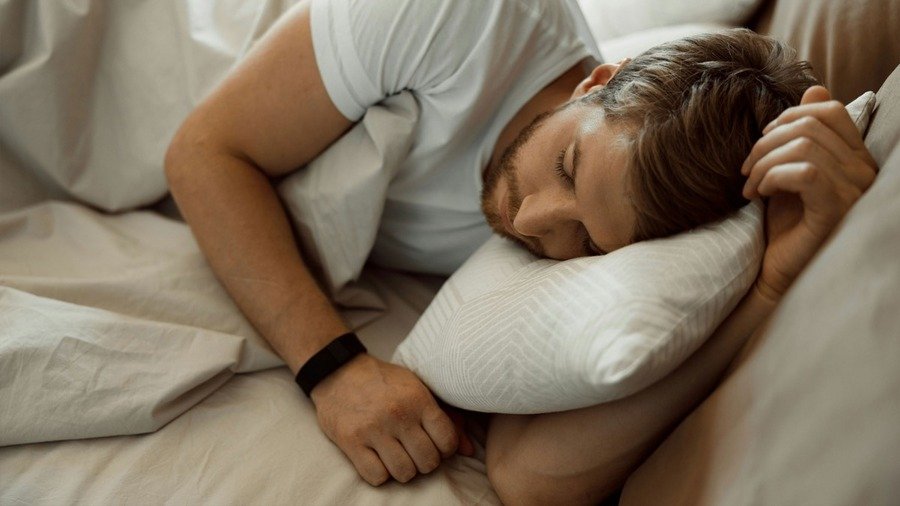
We won't promise the surge vanishes in a week. Anticipatory anxiety loops are usually months in the making and take weeks to undo. Most people notice softer evenings within 1–3 weeks of consistent practice. The lasting break from the loop usually takes longer.
If your pre-bed anxiety is part of a wider anxiety disorder, panic, or significant evening distress, please see your GP. Hypnotherapy can support but is not a substitute for clinical anxiety care. NHS anxiety guidance.
About an hour before bedtime works best — early enough to settle the evening, recent enough to carry into sleep. Some people also use the session in bed itself for the descent.
It usually softens — less intense, less prolonged, less amplified. Some evenings may remain difficult but the trend is towards less reactivity over weeks.
Yes — many people use the session alongside prescribed medication. Coordinate any changes with your GP. The session works on state, not chemistry.
If you experience actual panic at bedtime, please speak to your GP. Hypnotherapy can support but panic disorder usually benefits from clinical anxiety treatment alongside.
It can. Many people use the session in the middle of the night when the surge wakes them. Others use it preventatively in the evening to lower the baseline.
Around 15 minutes. Delivered within 30 minutes. Yours forever.
No specific belief is required. You remain in control throughout.